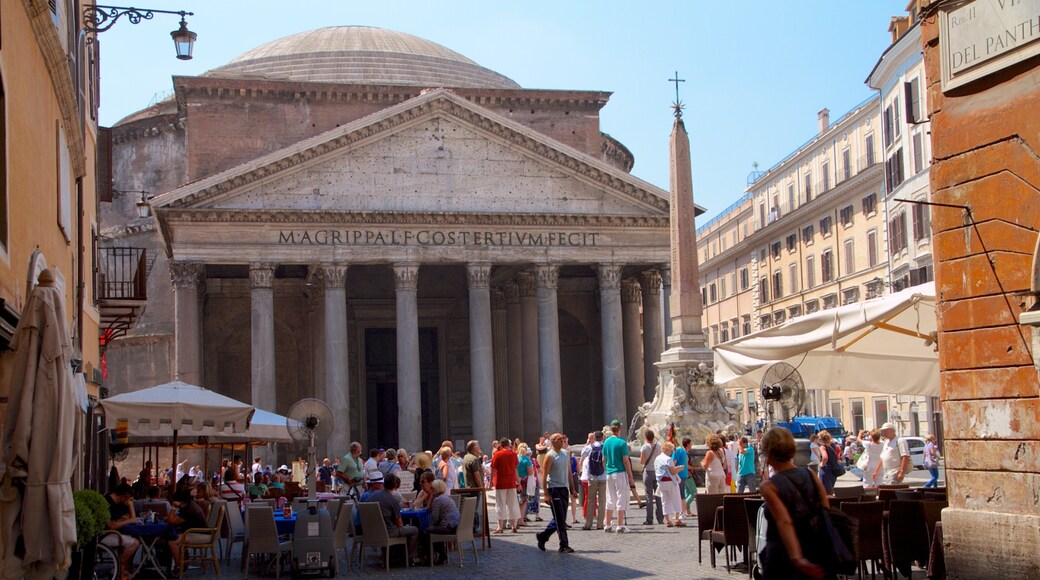


Despite weathering nearly 2 millennia, the Pantheon in the centre of Rome remains one of the best-preserved relics of the classical empire. Its striking columned façade and unparalleled architectural dome are testament to the skill and artistry of the age.
It was originally built under the orders of General Marcus Agrippa in the 1st century BC, but was razed to the ground by fire in 27 BC. The structure in its current form was rebuilt in the year 126 by Emperor Hadrian, as a temple to the Ancient Roman gods. Somewhat confusingly, the inscription still states “Marcus Agrippa, son of Lucius, made this building when consul for the third time”, but it is known that Hadrian only ever associated his name with one building: his father’s temple.
As you cross the Piazza della Rotonda, admire the iconic structure with its row of eight granite Corinthian columns supporting the pediment, a vast triangle of stone. This would once have borne a relief sculpture of the Battle of the Titans, but with the passage of time, the surface now appears blank.
Stepping into the building, you’ll pass two further rows of columns, before entering the awe-inspiring space of the rotunda, under the largest unreinforced concrete dome in existence. Designed with exquisite symmetry, the height from the floor to the apex (43 metres) is matched exactly by the diameter of the dome.
Look up, and you will see a circular opening, or oculus, in the centre of the domed ceiling. This allows a shaft of natural light to enter, mimicking the shape of sun. Look down, and you’ll see the chequered floor, unchanged since Roman times, contrasting with the circular lines of the dome.
The well-preserved state of the Pantheon is explained by its constant use through the centuries. Gifted to the Christian church in 609, its consecration protected it from decay and destruction in the medieval period. Works of art from the Renaissance hang in the rotunda, and key figures from Italian history are buried here, including the artist Raphael and king Umberto I.
The Pantheon is open daily. The surrounding streets are too narrow for buses, so travelling by taxi or on foot are the best options.